
Quick Answer
Professional fence staining in Jacksonville, FL typically costs $1.50 to $4.00 per linear foot for a standard wood privacy fence, or $350 to $1,200 for most residential projects. The final price depends on fence length, height, wood condition, stain type, and how much preparation work is needed. DIY staining runs $0.40 to $1.00 per linear foot in materials only.
In Florida’s climate, staining a wood fence every 2 to 3 years is typical — shorter than the national average of 3 to 5 years — because of the intense UV, humidity, and rain that accelerate wood degradation.
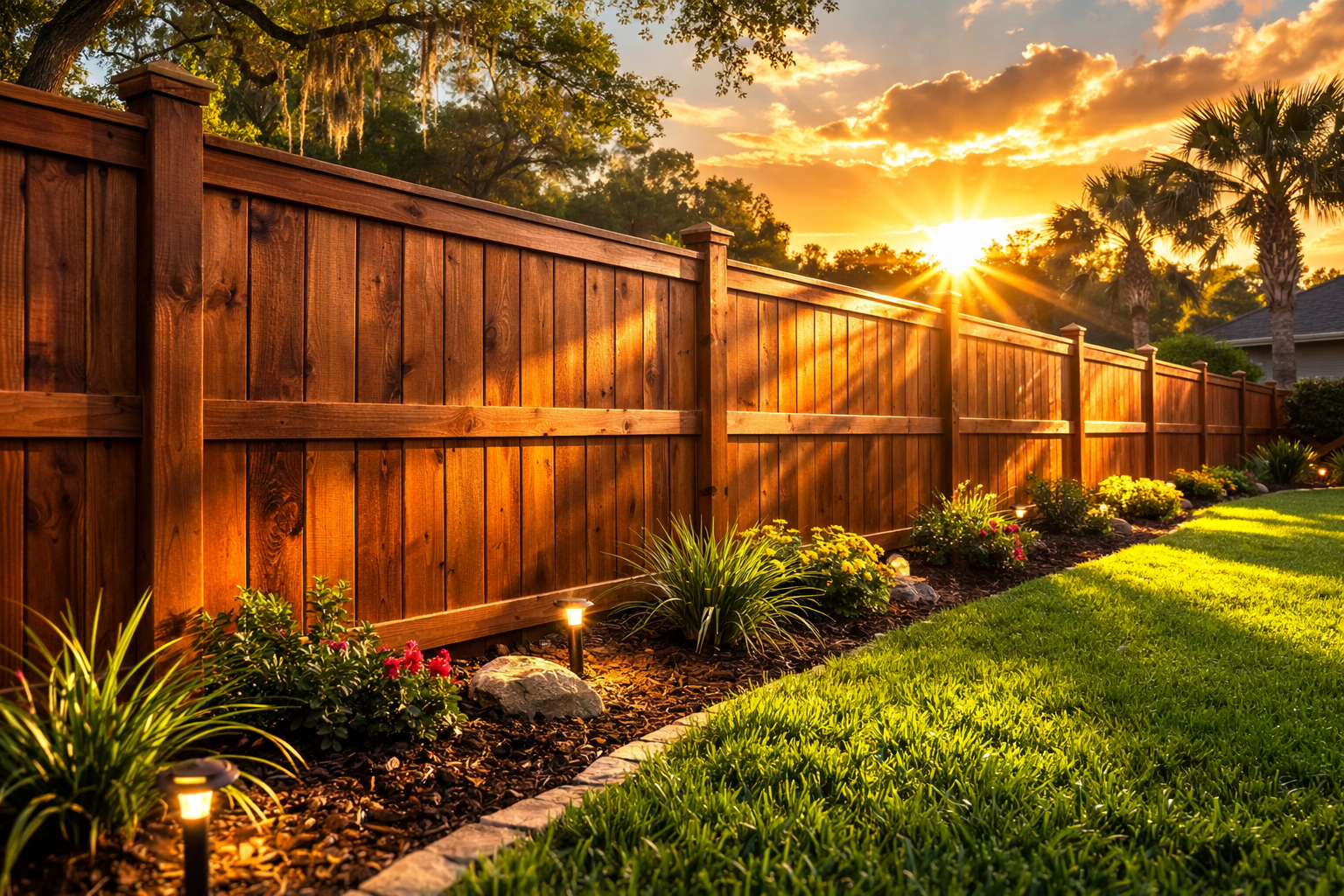
A wood fence is a significant investment. In Jacksonville, where a privacy fence around a typical backyard can run 150 to 300 linear feet or more, keeping that fence protected from Florida’s sun, humidity, and rain is not optional — it is the difference between a fence that lasts 15 years and one that starts rotting or graying out in five.
Staining is the most effective and most cost-efficient way to protect a wood fence. But before you call a contractor or head to the paint store, it helps to know what you are actually looking at in terms of cost — and what drives that cost up or down. This guide gives you a practical budget calculator, a breakdown of every cost factor, and the Florida-specific context that makes fence staining here different from the rest of the country.
Who wrote this: A New Leaf Painting has been staining and painting wood fences across Jacksonville and Northeast Florida since 2001. We know what Florida’s UV and humidity do to untreated wood, which stain products actually hold up here, and what a fair price looks like for this market.
Fence Staining Cost Calculator: Estimate Your Budget by Fence Size
The fastest way to rough-estimate your fence staining cost is by linear footage. Use the table below as your starting point, then use the sections that follow to adjust up or down based on your specific fence’s condition, style, and location.
|
Fence Length |
DIY Materials Only |
Pro: Basic |
Pro: Standard |
Pro: Premium |
|
50 linear feet |
$20–$50 |
$75–$125 |
$125–$175 |
$175–$250 |
|
100 linear feet |
$40–$100 |
$150–$250 |
$250–$350 |
$350–$500 |
|
150 linear feet |
$60–$150 |
$225–$375 |
$375–$525 |
$525–$750 |
|
200 linear feet |
$80–$200 |
$300–$500 |
$500–$700 |
$700–$1,000 |
|
250 linear feet |
$100–$250 |
$375–$625 |
$625–$875 |
$875–$1,250 |
|
300 linear feet |
$120–$300 |
$450–$750 |
$750–$1,050 |
$1,050–$1,500 |
Basic tier: one coat, minimal prep, standard stain product. Standard tier: full pressure wash, one to two coats, premium stain. Premium tier: full prep including wood brightener treatment, two full coats of top-grade penetrating stain, detail work on posts and trim.
How to measure your fence: Walk your fence line and count linear feet. For a standard 6-foot privacy fence, the paintable surface on one side is approximately your linear footage times 6 feet of height. If you are staining both sides, double that number. Most residential estimates are based on one side only unless you specify both.
What Drives Fence Staining Costs Up or Down in Jacksonville
The calculator ranges above are starting points. Here are the specific factors that move your actual price toward the lower or higher end of those ranges.
Fence Size and Height
Linear footage is the primary cost driver — more fence means more labor and more material. Height matters too. A standard 6-foot privacy fence has twice the surface area of a 3-foot picket fence at the same linear footage. Most professional quotes calculate by total surface square footage rather than just linear feet, so a taller fence will cost proportionally more even at the same length.
Fence Style and Complexity
Solid privacy fences are the fastest to stain because there are no gaps and the surface is relatively continuous. Open-style fences — picket fences, split-rail, lattice-top panels — take significantly more time because every individual board or slat has multiple exposed edges and surfaces. A 100-linear-foot picket fence can take twice as long to stain as a 100-linear-foot privacy fence.
Current Wood Condition
This is the biggest variable that surprises homeowners when they get a quote. A fence in good condition with no mildew, no gray weathering, and sound wood is relatively quick and inexpensive to prep. A fence that has been neglected for several years — with significant gray weathering, mildew growth, or surface contamination — needs more work before stain can be applied.
- Clean fence, good condition: Quick pressure wash and dry. Minimal prep cost.
- Gray and weathered but structurally sound: Pressure wash plus wood brightener (oxalic acid treatment) to open the grain and restore wood color before staining. Adds $0.25 to $0.75 per linear foot.
- Mildew, algae, or significant contamination: Mildewcide pre-treatment plus thorough washing. Adds $0.25 to $0.50 per linear foot.
- Old stain or paint that is peeling: Stripping old finish adds significant labor. Stripping can cost as much as the staining itself — sometimes more.
Stain Product Quality
Stain products range from basic hardware-store deck stains around $25 to $35 per gallon to premium penetrating oil stains like Defy Extreme, Armstrong Clark, or Cabot Australian Timber Oil at $50 to $80 per gallon. Premium products penetrate deeper into the wood fiber, resist UV and mildew longer, and need to be reapplied less frequently — which matters a lot in Jacksonville’s climate.
Number of Coats
New, bare wood typically absorbs two coats of stain, especially with penetrating oil products. Previously stained wood in good condition usually only needs one fresh coat. Two coats mean more material and more labor, which is reflected in the standard and premium tiers of the calculator above.
One Side vs. Both Sides
Most fence quotes cover one side — the side facing outward or the side specified by the homeowner. Staining both sides roughly doubles the material cost and adds 60 to 70 percent more labor (posts and rails are shared, which is why it is not a full double on labor). If your fence borders a shared property line or a highly visible street-facing exposure, staining both sides is worth the additional investment.
|
Cost Factor |
Impact on Price |
Florida-Specific Note |
|
Fence length (linear feet) |
Primary driver |
Most Jacksonville backyards run 150–300 LF |
|
Fence height and style |
Moderate to significant |
Picket/lattice takes 2x longer than solid privacy |
|
Wood condition and weathering |
Significant |
FL humidity and UV gray wood faster than other climates |
|
Old finish stripping |
High — can double the job cost |
Common on fences 6+ years old with failing stain |
|
Stain product tier |
Moderate |
Premium stain is worth it in FL — lasts 2–3x longer |
|
Number of coats |
Moderate |
New wood and weathered wood both need 2 coats |
|
One side vs. both sides |
60–90% additional |
Both sides recommended for shared or street-facing fences |
Types of Fence Stain: Which One Is Right for a Florida Fence?
Not all fence stains are the same, and in Jacksonville’s climate the product you choose has a direct impact on how long the finish lasts and how much maintenance your fence needs over the years.
Penetrating Oil-Based Stain: The Best Choice for Florida Wood Fences
Penetrating oil stains soak into the wood fiber rather than sitting on top of the surface. Because the stain is inside the wood rather than forming a film on top of it, it cannot peel, crack, or blister — the three failure modes that plague film-forming products in Florida’s climate. When it does wear, it weathers gradually and evenly rather than failing suddenly in large patches.
For Jacksonville’s combination of UV radiation, humidity, and heavy rain, penetrating oil stain is the professional recommendation for virtually all wood fences. Top products in this category include Defy Extreme Wood Stain, Armstrong Clark Wood Stain, and Cabot Australian Timber Oil — all of which are engineered with UV blockers and mildewcide additives that significantly outperform basic deck stains in Florida conditions.
Water-Based Semi-Transparent Stain: A Practical Mid-Tier Option
Water-based semi-transparent stains are easier to apply, dry faster, and clean up with water instead of mineral spirits. They do not penetrate as deeply as oil-based products but still provide reasonable UV and moisture protection. They are a practical choice for budget-conscious homeowners who plan to restain on a regular schedule rather than stretching years between applications. In Jacksonville, expect to restain every two years with a quality water-based product versus three to four years with a premium oil-based stain.
Solid Stain and Paint: When and Why to Avoid Them on Fences
Solid stain and exterior paint both form a film on top of the wood rather than penetrating into it. That film looks great initially but creates a specific problem on fences: wood movement. Fences expand and contract constantly with Florida’s temperature swings and humidity cycles. A film-forming product on a moving wood surface eventually cracks, peels, and delaminate — often within two to three years in Jacksonville’s conditions.
Solid stain and paint also trap moisture beneath the film when the film fails, which accelerates wood rot. For wood fences, penetrating stain is almost always the better long-term choice. Solid stain or paint is appropriate for smooth composite fence materials where wood movement is not a factor.
Avoid painting wood fences in Florida: Once a wood fence has been painted with a film-forming product, it must be repainted or stripped every few years. Stripping is labor-intensive and expensive. Starting with a penetrating stain that weathers gracefully and re-coats easily is a significantly better long-term strategy for any wood fence in Jacksonville.
How Jacksonville’s Climate Affects Fence Stain Lifespan
Wood fences in Jacksonville age faster than fences in most of the country. Here is what Florida’s specific conditions do to an unprotected or poorly protected wood fence — and why stain choice and application quality matter so much here.
UV Radiation Grays Wood Fast
Jacksonville’s 233-plus sunny days per year rapidly break down the lignin in wood surface fibers — the component that gives wood its natural color and structural integrity at the surface. Within six to twelve months of installation, untreated or unstained pine fence boards start showing visible gray weathering. Within two to three years, that weathering is deep enough to feel rough and begin creating surface checking (small surface cracks).
Penetrating stains with UV blockers slow this process significantly. Premium products like Defy Extreme contain zinc nano-particle UV protection that absorbs and dissipates UV radiation before it can attack the wood fibers. On a Jacksonville fence that gets full afternoon sun on a west-facing exposure, the difference between premium and budget stain in UV protection shows clearly within the first two years.
Humidity and Rain Promote Mildew and Wood Rot
Jacksonville’s year-round humidity keeps wood fences damp for extended periods after rain. That sustained moisture creates ideal conditions for mildew growth on fence surfaces and, in poorly maintained fences, wood-destroying fungi that cause rot. Premium fence stains include mildewcide additives that inhibit biological growth on the surface — critical for Jacksonville fences that spend most of the year in humid conditions.
The base of fence posts, where wood meets soil or concrete, is the most rot-vulnerable point on any fence. While stain protects the above-ground surface, posts set in soil should ideally use pressure-treated lumber rated for ground contact. No stain product fully compensates for inadequately treated post material in Florida’s high-moisture ground conditions.
How Often to Restain a Fence in Jacksonville
|
Stain Product Type |
Jacksonville Interval |
National Average |
Key Variable |
|
Premium penetrating oil stain |
3–4 years |
4–5 years |
UV exposure; full vs. partial sun |
|
Mid-tier water-based stain |
2–3 years |
3–4 years |
Humidity; mildew resistance quality |
|
Budget deck stain |
1–2 years |
2–3 years |
UV; often fails rapidly in FL conditions |
|
Solid stain (film-forming) |
2–3 years before peeling |
3–4 years |
Film failure from wood movement in FL heat |
Restaining on time is always cheaper than waiting: A fence stained before the existing finish is fully depleted typically needs only one coat and minimal prep. A fence where the old finish has failed completely, wood has grayed, and surface mildew has developed needs stripping, brightening, and two coats. That job can cost two to three times more than a timely maintenance coat would have.
DIY vs. Professional Fence Staining in Jacksonville: What Is the Real Difference?
Fence staining is one of the more accessible exterior projects for a handy homeowner. But there are real tradeoffs between doing it yourself and hiring a professional, and understanding them helps you make the right call for your specific situation.
|
Factor |
DIY Staining |
Professional Staining |
|
Upfront cost |
Low — materials only ($40–$300) |
Higher — full project cost ($150–$1,500+) |
|
Time required |
Full weekend for average fence |
1–2 days for most residential projects |
|
Equipment needed |
Brush, roller, or sprayer; pressure washer |
Provided by contractor |
|
Prep quality |
Varies — most DIY skips critical steps |
Full prep is standard for professional work |
|
Product access |
Limited to retail products |
Access to contractor-grade products |
|
Application consistency |
Varies with skill and equipment |
Consistent coverage; professional spray technique |
|
Longevity |
Shorter if prep is rushed |
Longer with proper prep and application |
|
Warranty |
None |
Workmanship warranty included |
DIY fence staining is absolutely doable for a homeowner with time and patience. The most common DIY mistakes are rushing the prep — not cleaning the fence thoroughly enough before staining — and applying stain in direct afternoon sun, which causes the product to dry too fast before it can fully penetrate the wood. Both of those mistakes result in a finish that looks okay initially but starts failing within a year.
Professional staining makes the most sense for large fences over 150 linear feet, fences that need significant prep work or stripping of old finish, complex picket or lattice styles that are tedious to stain by hand, and any homeowner who simply does not want to spend a weekend on a hot Jacksonville afternoon on their knees with a brush.
Fence Preparation: The Step That Determines How Long the Stain Lasts
The single most important factor in how long a fence stain lasts in Jacksonville is what happened to the fence surface before the stain was applied. Stain applied to a clean, open-grain wood surface lasts dramatically longer than the same stain applied to a dirty, weathered, or contaminated surface.
Step 1: Pressure Wash Thoroughly
The entire fence gets pressure washed to remove dirt, mildew, pollen, and loose wood fibers. In Jacksonville, even a relatively new fence will have accumulated mildew on shaded sections and significant pollen and organic debris in the wood grain. A garden hose rinse does not accomplish what a pressure washer does — the mechanical action of the pressure wash opens the wood grain and removes embedded contamination.
Step 2: Apply Wood Brightener on Weathered Fences
For any fence that shows significant gray weathering — which in Jacksonville means most fences over two or three years old without recent maintenance — a wood brightener application after pressure washing is the step that makes the biggest difference in final results. Wood brightener (typically an oxalic acid-based product) neutralizes the gray oxidized wood fibers, opens the wood grain, and restores the wood’s natural color. Stain applied after a brightener treatment penetrates deeper and more evenly than stain applied to gray, oxidized wood.
Step 3: Allow Full Drying Time
After washing and brightening, the fence must dry completely before stain is applied — 24 to 48 hours minimum in Jacksonville’s humidity. Staining wet or damp wood prevents penetration and leads to early failure. This is the step most DIYers rush, and it is the step that has the biggest impact on how long the finished stain holds up.
Step 4: Apply Stain in the Right Conditions
For Jacksonville, that means morning application before surface temperatures climb above 90 degrees, air temperature between 50 and 90 degrees, and no rain forecast for at least 24 hours. Late spring and fall — March through May and October through November — are the best seasons for fence staining in Northeast Florida. Summer staining is possible but requires careful early-morning scheduling to avoid the afternoon heat and daily storm risk.
Frequently Asked Questions: Fence Staining in Jacksonville, FL
How much does it cost to stain a fence in Jacksonville, Florida?
Professional fence staining in Jacksonville costs $1.50 to $4.00 per linear foot for most wood privacy fences, or $350 to $1,200 for a typical residential project. The lower end applies to clean, well-maintained fences needing one coat of standard stain. The higher end applies to larger fences, complex styles like picket or lattice, fences needing significant prep work, or projects using premium two-coat penetrating oil stain systems.
How often should you stain a wood fence in Florida?
In Jacksonville’s climate, most wood fences need restaining every 2 to 4 years. Premium penetrating oil stains on a well-maintained fence can stretch to 4 years. Budget water-based stains on a fully sun-exposed fence may need refreshing every 1 to 2 years. The national average of 3 to 5 years does not account for Florida’s UV intensity and humidity, which accelerate stain degradation. Restaining before the existing finish fails completely saves significant prep time and cost.
Is it better to stain or paint a wood fence in Florida?
Stain — specifically a penetrating oil-based stain — is almost always the better choice for wood fences in Florida. Penetrating stains soak into the wood fiber and cannot peel or blister, unlike paint or solid stain which form a film on top of the wood. In Jacksonville’s climate, where wood fences expand and contract constantly with heat and humidity swings, film-forming products typically crack and peel within two to three years. Penetrating stain weathers gracefully, re-coats easily without stripping, and protects the wood better long-term.
What is the best fence stain for Florida’s climate?
The best fence stains for Florida’s climate are premium penetrating oil stains with built-in UV blockers and mildewcide additives. Top-performing products include Defy Extreme Wood Stain, Armstrong Clark Wood Stain, and Cabot Australian Timber Oil. These products penetrate deeply into the wood, provide strong UV protection against Jacksonville’s intense sun, and include mildewcide chemistry that resists the biological growth Florida’s humidity promotes. All three significantly outperform basic hardware-store deck stains in Florida conditions.
How do I know if my fence needs to be restained?
The water bead test is the most reliable indicator. Sprinkle water on the fence surface. If it beads up and rolls off, the existing stain is still protecting the wood. If it soaks in immediately and darkens the wood, the stain has been depleted and the wood is absorbing moisture unprotected. Other signs include visible gray weathering on fence boards, mildew staining that returns quickly after washing, surface checking (small cracks in the wood grain), and areas where old stain is visibly flaking or peeling.
About A New Leaf Painting — Fence Staining in Jacksonville and Northeast Florida
A New Leaf Painting has been staining and painting wood fences across Jacksonville and Northeast Florida since 2003. We understand what Florida’s specific conditions demand from a fence stain system — the UV exposure, the mildew pressure, the humidity that keeps wood surfaces damp — and we use products and techniques specifically suited to this climate.
Every fence staining project we take on starts with a thorough assessment of the wood’s current condition. We do not skip prep, and we do not apply stain to surfaces that are not ready for it. That approach is what produces a finish that holds up for three to four years in Jacksonville rather than failing in the first rainy season.
Ready to Protect Your Jacksonville Fence?
Call or text 904-615-6599 for a free fence staining estimate.
Serving Jacksonville • Jacksonville Beach • Ponte Vedra • Atlantic Beach • Fleming Island • Orange Park • Amelia Island