
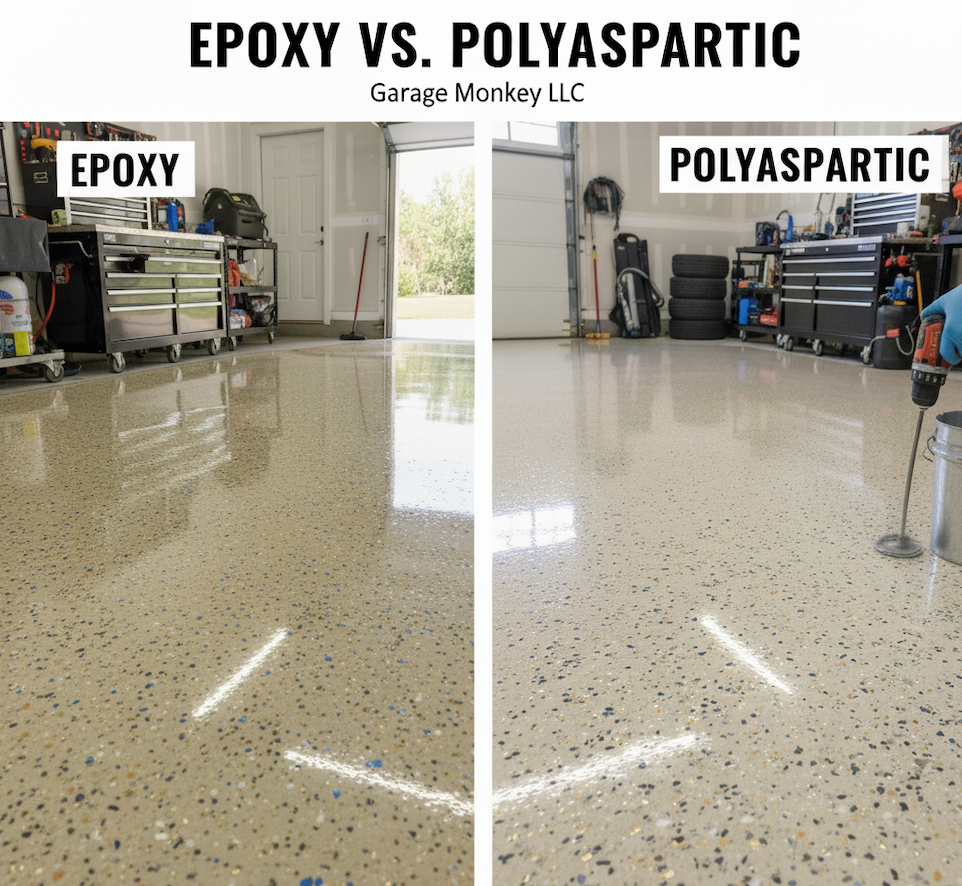
Why Comparing Polyaspartic and Epoxy Costs Requires More Than a Per-Square-Foot Number
When Jacksonville homeowners start comparing polyaspartic and epoxy garage floor coatings, the conversation usually starts with price per square foot. That is a reasonable starting point — but it misses most of the story. In Florida’s specific climate conditions, the 20-year total cost of ownership for these two systems looks very different from the upfront installation cost.
This guide breaks down both the upfront and lifetime costs of polyaspartic and epoxy floor coatings for Jacksonville homes, and gives you the information you need to make a decision that makes sense for your specific situation.
Polyaspartic vs. Epoxy: Side-by-Side Cost Comparison
| Cost Factor | Polyaspartic | Standard Epoxy | Notes |
| Installation cost per sq ft | $5-$7 | $3-$5 | Jacksonville 2026 pricing |
| Typical 2-car garage (450 sq ft) | $2,250-$3,150 | $1,350-$2,250 | Before any add-ons |
| Typical 3-car garage (650 sq ft) | $3,250-$4,550 | $1,950-$3,250 | Before any add-ons |
| Crack repair (per crack) | $50-$150 | $50-$150 | Same for both systems |
| Moisture mitigation primer | $1-$2 per sq ft | $1-$2 per sq ft | Recommended in FL |
| Expected lifespan (FL climate) | 15-20+ years | 5-10 years | With professional installation |
| Recoat frequency (20 years) | 0-1 times | 2-3 times | Significant cost difference |
| 20-year total cost estimate | $2,250-$3,150 | $4,050-$6,750 | Including recoats |
The 20-year total cost figures above assume polyaspartic requires no recoat in the first 20 years (realistic for professional installation in a residential garage) and epoxy requires two recoats at similar cost. These are conservative estimates — in Jacksonville’s climate, epoxy often requires recoating on the shorter end of the 5-10 year range.
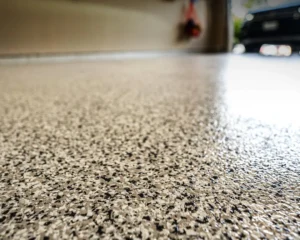
What Drives the Cost Difference Between Polyaspartic and Epoxy?
Understanding why polyaspartic costs more helps evaluate whether the premium is justified for your specific situation.
1. Material Cost
Polyaspartic and polyurea raw materials cost more than standard epoxy resins. Polyaspartic is a more chemically sophisticated product — the formulation that gives it UV stability, flexibility, and fast cure time requires more expensive chemistry than standard two-part epoxy. Material cost accounts for roughly 40 to 50 percent of the installation price difference between the two systems.
2. Application Complexity
Polyaspartic systems cure significantly faster than epoxy — which means the installation window is tighter and requires more experienced applicators. A contractor who is not familiar with polyaspartic’s working time can produce an uneven finish if they are not working efficiently. This expertise requirement is reflected in the labor cost. Epoxy, which has a longer working time, is more forgiving to apply — which is partly why it is less expensive.
3. Surface Preparation
Both systems require the same surface preparation — diamond grinding, crack repair, and moisture testing. The preparation cost is similar regardless of which coating system is used. Where homeowners sometimes get misled is by contractors who quote lower-priced epoxy with minimal surface preparation. The coating product is not where corners should be cut — preparation is what determines longevity.
4. Topcoat System
Polyaspartic systems typically include a UV-stable polyaspartic or polyurea topcoat that will not yellow, chalk, or degrade in Florida’s sun. Standard epoxy systems often use an epoxy topcoat that lacks UV stability — it may look good initially but will yellow and chalk within 2 to 4 years of sun exposure, particularly on garage floors near frequently-open doors. Upgrading an epoxy system with a UV-stable polyaspartic topcoat narrows the cost gap between the two systems.
When Epoxy Makes Financial Sense in Jacksonville
Despite polyaspartic’s performance advantages, standard professional epoxy is the right choice in specific situations.
- Budget-constrained projects: If the upfront cost difference is the primary constraint and the homeowner plans to sell the home within 5-7 years, the premium for polyaspartic may not provide sufficient return.
- Low-UV interior spaces: For enclosed garages where the floor receives minimal direct sun exposure and hot-tire exposure is limited, standard epoxy’s UV limitations are less relevant.
- Short-term rental properties: For investment properties where the coating needs to look good for 5-7 years rather than 15-20, epoxy at the lower upfront cost may be the pragmatic choice.
- Supplementary coating: In some situations, a standard epoxy base coat under a polyaspartic topcoat provides a cost-effective middle ground — combining epoxy’s affordability with polyaspartic’s UV stability at the surface.
When Polyaspartic is Worth Every Dollar in Jacksonville
- Primary residence: For a home you plan to own long-term, polyaspartic’s 15-20+ year lifespan eliminates one or two full recoat cycles compared to epoxy — making it the lower total-cost option in most scenarios.
- High-heat garages: Any garage that sees significant vehicle traffic and sun exposure benefits substantially from polyaspartic’s hot-tire resistance and UV stability.
- High-humidity environments: Homes near the coast or with known moisture vapor issues in the slab are better served by polyaspartic’s superior moisture tolerance.
- Appearance priority: If maintaining the floor’s showroom appearance over the long term matters, polyaspartic’s UV stability and durability justify the premium.
- Driveways and outdoor surfaces: Any surface with direct sun exposure requires a UV-stable coating system — standard epoxy is not appropriate for outdoor applications in Jacksonville.
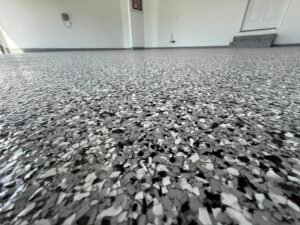
Frequently Asked Questions — Polyaspartic vs. Epoxy Cost in Jacksonville
Is polyaspartic worth the extra cost over epoxy in Florida?
For most Jacksonville homeowners in their primary residence, yes — particularly in garages with frequent vehicle traffic and sun exposure. The typical cost premium for polyaspartic over epoxy on a two-car garage is $900 to $1,500 upfront. Over a 20-year period, polyaspartic typically requires no recoating while epoxy requires two full recoats — making the 20-year cost of polyaspartic lower in most residential scenarios despite the higher upfront price.
Why does polyaspartic cost more than epoxy?
Polyaspartic costs more than epoxy because the raw materials are more expensive and the application requires more experienced applicators due to the faster cure time. The additional cost reflects a more sophisticated chemistry that delivers superior UV stability, flexibility, moisture vapor tolerance, and hot-tire resistance — all of which are particularly relevant in Jacksonville’s climate.
What is included in a professional garage floor coating estimate?
A professional garage floor coating estimate from A New Leaf Painting includes diamond grinding for surface preparation, crack repair, moisture testing, base coat application with decorative flake broadcast, clear topcoat, and full cleanup. The estimate is itemized and locked — the price quoted is the price paid, with no surprise charges after the project starts.
How much does a 2-car garage floor coating cost in Jacksonville?
A typical two-car garage floor coating in Jacksonville, FL costs between $1,350 and $2,250 for professional epoxy and $2,250 to $3,150 for professional polyaspartic, based on 450 square feet and 2026 pricing. Crack repair, moisture mitigation primer, and other add-ons are priced separately. A New Leaf Painting provides free, itemized estimates for every garage floor coating project in Jacksonville.
A New Leaf Painting — Epoxy & Concrete Coating Specialists in Jacksonville, FL
A New Leaf Painting has been installing professional-grade epoxy and concrete floor coatings in Jacksonville since 2001. Our polyurea and polyaspartic floor systems are built specifically for Florida’s heat, humidity, and hot-tire conditions — and they dramatically outperform the peel-and-chip kits from the hardware store. We install professional floor coating systems for residential garages, driveways, patios, and pool decks throughout Jacksonville, Ponte Vedra Beach, Fleming Island, Orange Park, St. Augustine, Atlantic Beach, Amelia Island, and the surrounding Northeast Florida region.
Every floor coating project begins with diamond grinding for proper surface preparation, moisture testing, crack repair, and a base coat application — because a coating is only as good as the surface underneath it. We use professional-grade polyurea and polyaspartic systems that cure in hours, resist hot-tire pickup, and hold up under Florida’s UV and humidity for 15 to 20+ years. Every project is backed by our Iron-Clad Guarantee: professional results or your coating is 100% free.
Wondering what it costs before you call? Our concrete coating cost guide breaks down real Jacksonville pricing so you know exactly what to expect before we ever set foot on your property. We also offer complete exterior painting, interior painting, stucco repair, carpentry repairs, and power washing — one company for everything your home needs. When you are ready, call or text 904-615-6599 for a free, no-surprise estimate.