


Quick Answer
Painting stucco homes in Jacksonville requires specialized products and preparation because stucco develops hairline cracks from Florida’s heat-driven thermal expansion and needs coatings that can bridge those cracks rather than just paint over them. The professional standard for Jacksonville stucco homes is elastomeric coating — a thick, flexible product that stretches across micro-cracks and forms a continuous waterproof membrane. Premium acrylic latex is appropriate for newer stucco in good condition with no active cracking.
With proper preparation and the right coating, stucco paint on a Jacksonville home should last 8 to 12 years. The most common reason stucco paint fails early is skipped preparation — particularly painting over hairline cracks without repairing them first.
If your home has a stucco exterior, you are in good company. The majority of homes built in Jacksonville and Northeast Florida over the past four decades use stucco as their exterior finish. It is durable, fire-resistant, low-maintenance, and gives Florida homes a clean, classic look. But stucco has specific characteristics that make painting it very different from painting wood or fiber cement siding — and understanding those differences is the key to getting a paint job that actually lasts.
The most important thing to know going in: stucco and Florida’s climate are in a constant tug-of-war. Heat causes stucco to expand. Cooler temperatures cause it to contract. Repeat that cycle thousands of times over years, and you get the hairline cracks that show up on virtually every Jacksonville stucco home eventually. Those cracks are not just cosmetic — they are entry points for the moisture, mildew, and water infiltration that do real damage to the structure beneath.
This guide covers everything you need to know about painting stucco homes in Jacksonville: why standard paint is not always the right answer, how to tell the difference between a surface that needs elastomeric coating versus standard acrylic, what proper preparation actually looks like, how long to expect a stucco paint job to last, and what warning signs tell you it is time to repaint.
Who wrote this: A New Leaf Painting has been painting stucco homes in Jacksonville and Northeast Florida since 2003. More than 5,000 exterior projects, the majority of them stucco. We have seen every variety of stucco condition and failure mode that Florida’s climate produces, and our recommendations here are based on what we have learned from doing this work on real homes in this specific environment.
Why Stucco Homes Require a Different Approach to Exterior Painting


Why Stucco Homes Require a Different Approach to Exterior Painting
Stucco is not like painting wood siding or fiber cement. Those surfaces are relatively inert — they hold paint well as long as the surface is clean and properly primed. Stucco is a living, breathing masonry material that moves, cracks, and interacts with moisture in ways that standard paint cannot always handle. Understanding what makes stucco different explains every decision that follows.
What Stucco Actually Is
Traditional stucco is a mixture of Portland cement, sand, and water applied in layers directly over a wire mesh substrate. Modern synthetic stucco (sometimes called EIFS — Exterior Insulation and Finish System) uses a foam board base with a textured acrylic finish coat. The vast majority of Jacksonville homes built in the 1980s, 1990s, and 2000s use traditional three-coat Portland cement stucco.
Cement-based stucco is hard and rigid. That rigidity is part of what makes it durable, but it also means it has limited ability to flex. When the surface it is bonded to expands or contracts — as all building materials do with temperature and moisture changes — the stucco has to either flex with it or crack. In Florida’s climate, cracking is the more common outcome.
How Florida’s Climate Creates Stucco Cracks
Jacksonville’s temperature range runs from overnight lows in the 30s during winter cold fronts to surface temperatures well above 100 degrees on west-facing walls during summer afternoons. That is a meaningful temperature swing for any material, and for stucco — which has a relatively high coefficient of thermal expansion — it produces measurable movement every single day.
Compounding the thermal cycle is Jacksonville’s humidity. When stucco absorbs moisture during the rainy season and then dries out rapidly, it undergoes dimensional changes on top of the thermal movement. Over years and decades of these daily cycles, hairline cracks develop in the stucco surface. They are often barely visible until water gets into them and discolors the surface, but they are there on virtually every stucco home more than five or six years old.
Why this matters for painting: Standard exterior paint — even premium acrylic — is typically applied at 4 to 6 mils of dry film thickness. Hairline cracks in stucco can be 20 to 30 mils wide or more. Standard paint bridges nothing. It paints right over the crack, sealing the visible surface while leaving a direct water pathway into the masonry beneath. Every rain event after that is pushing water into the wall through those unsealed cracks.
Stucco’s Porosity: The Moisture Challenge
Stucco is porous. Unlike fiber cement or vinyl siding, which shed water off a relatively impermeable surface, stucco absorbs a small amount of water every time it rains. The coating system applied over stucco has to manage that moisture without trapping it inside the masonry, which would cause efflorescence, spalling, and eventually structural damage.
This is why the breathability of the coating matters. Elastomeric coatings, despite being waterproof on the surface, are formulated to allow moisture vapor to escape from the masonry rather than trapping it. This balance — waterproof from the outside, breathable from the inside — is essential for long-term stucco health in Florida’s high-moisture environment.
Elastomeric Coating vs. Acrylic Paint for Jacksonville Stucco: Which Do You Need?
The most important product decision for any Jacksonville stucco painting project is whether to use an elastomeric coating or a premium acrylic latex paint. These are not interchangeable — they are fundamentally different products designed for different surface conditions. Using the wrong one is one of the most common mistakes homeowners and inexperienced painters make on stucco projects.
What Elastomeric Coatings Are and How They Work
Elastomeric coating is not paint in the conventional sense. It is a thick, rubber-like coating applied at 10 to 20 mils of dry film thickness — two to five times the thickness of standard exterior paint. The word “elastomeric” refers to the coating’s ability to stretch. A quality elastomeric product can elongate 200 to 400 percent before failing, which means it can stretch across hairline cracks in stucco without cracking itself.
When applied correctly over a properly prepared stucco surface, elastomeric coating forms a continuous, seamless waterproof membrane across the entire wall. Hairline cracks that exist in the stucco are bridged by the thick coating film above them. New micro-cracks that develop from thermal movement after painting are also bridged, as long as they remain within the hairline range. The result is a wall that sheds water comprehensively rather than relying on the absence of cracks.
What Premium Acrylic Latex Does on Stucco
Premium acrylic latex paint — products like Sherwin-Williams Emerald, Duration, or Benjamin Moore Aura — is an excellent coating for stucco surfaces that are in good condition with no active cracking. Applied in two full coats, a premium acrylic provides outstanding UV resistance, mildew resistance, moisture repellency, and color retention. On newer stucco with a sound, tight surface, it will perform beautifully and last eight to twelve years.
The limitation is crack bridging. Standard acrylic latex does not have the film thickness or elongation properties to span hairline cracks. It is the right product for the right surface condition — but it is the wrong product when the stucco has developed cracking that needs to be bridged rather than just covered.
How to Decide Which Product Your Stucco Home Needs
The decision comes down to the current condition of your stucco surface. Here is the framework professional painters use:
|
Stucco Condition |
Recommended Coating |
Why |
|
New stucco, no cracking, smooth surface |
Premium acrylic latex (2 coats) |
Surface is tight; acrylic provides full UV and moisture protection |
|
Minor hairline cracks, mostly cosmetic |
Elastomeric coating |
Bridges existing cracks; prevents new ones from opening to water |
|
Moderate hairline cracking across surface |
Elastomeric coating (required) |
Acrylic will not bridge; water infiltration will cause rapid failure |
|
Larger cracks (1/8 inch+) |
Repair first, then elastomeric |
Cracks above hairline must be filled before any coating |
|
Previously painted with elastomeric |
Elastomeric coating (maintain system) |
Switching to acrylic over elastomeric creates compatibility issues |
|
Stucco near coast with salt air exposure |
Elastomeric coating |
Salt accelerates cracking; maximum waterproofing needed |
When in doubt, choose elastomeric: For any stucco home more than seven to ten years old in Jacksonville, elastomeric coating is almost always the right call. The cost difference per gallon is meaningful but not dramatic, and the performance difference on aging stucco is significant. The extra three to five years of lifespan that elastomeric delivers on cracked stucco typically more than offsets the higher upfront material cost.
Head-to-Head Comparison
|
Factor |
Elastomeric Coating |
Premium Acrylic Latex |
|
Dry film thickness |
10–20 mils |
4–6 mils |
|
Crack-bridging ability |
Excellent — up to 1/16” hairline cracks |
None to minimal |
|
Waterproofing |
Continuous waterproof membrane |
Strong water resistance, not waterproof |
|
UV resistance |
Good to very good |
Excellent (especially Emerald/Aura) |
|
Mildew resistance |
Good |
Excellent (with mildewcide additives) |
|
Best surface condition |
Cracked, aged, or coastal stucco |
New or sound stucco with no cracking |
|
Typical lifespan on stucco (Jacksonville) |
10–15 years |
8–12 years |
|
Cost per gallon (approx.) |
$55–$85 |
$65–$90 (premium lines) |
|
Application method |
Brush, roller, or airless sprayer + back-roll |
Brush, roller, or airless sprayer |
How to Prepare Stucco for Painting in Jacksonville: The Full Professional Process
If there is one thing that separates a stucco paint job that lasts twelve years from one that starts failing at four, it is preparation. Paint — whether elastomeric or acrylic — can only perform as well as the surface it bonds to. Skipping or rushing any of these steps is the most common reason stucco paint fails prematurely in Jacksonville’s demanding climate.

Step 1: Full Pressure Washing
Before anything else happens, the entire stucco surface gets thoroughly pressure washed. Jacksonville’s humidity means stucco regularly accumulates mildew, algae, dirt, pollen, and salt residue — even on homes that look reasonably clean at a glance. Any of that contamination left on the surface will prevent the new coating from bonding properly to the stucco.
The pressure washing process for stucco needs to be thorough but controlled. Too much pressure can damage stucco texture or force water into existing cracks. A good approach uses moderate pressure with a wide fan tip, working systematically from top to bottom, and applying a mildewcide solution before rinsing on any surfaces with visible biological growth.
After washing, the stucco must fully dry before any coating is applied. In Jacksonville’s humidity, that means waiting 24 to 48 hours — sometimes longer in unusually humid conditions. Applying paint to damp stucco traps moisture inside the masonry and causes adhesion failure from the inside out.
The drying wait is non-negotiable: Painters who want to move fast will sometimes paint stucco the same day it was washed, or the next morning after an afternoon wash. In Jacksonville’s humidity, that is not enough drying time. Stucco is porous and holds moisture longer than fiber cement or wood. Rushing this step is a common cause of early paint failure.
Step 2: Inspecting and Mapping All Cracks
Once the stucco is clean and dry, a thorough crack inspection is critical. Walk the entire exterior and identify every crack — from hairline surface cracks to larger structural cracks. Not all cracks are the same, and they do not all get treated the same way.
Hairline cracks — those less than about 1/16 inch wide — are the most common finding on Jacksonville stucco homes. These are addressed by elastomeric coating (which bridges them) plus elastomeric caulk in the more visible ones. Cracks larger than 1/16 inch need to be filled and patched before any topcoat goes on, because elastomeric coating alone cannot reliably bridge them.
Any crack that shows staining, efflorescence (white mineral deposits), or signs of active water entry needs particular attention. These are the spots where water has been infiltrating, and they need to be fully sealed before painting — not just coated over.

Step 3: Crack Repair and Patching
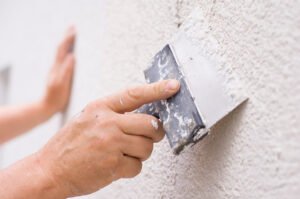
Cracks that need filling before painting are cleaned out with a wire brush or compressed air to remove any loose material, dust, or debris from inside the crack. They are then filled with a flexible elastomeric caulk or stucco patching compound, depending on the width and depth of the crack.
For wider cracks, the repair may need to be done in layers — applying the patching material in passes and allowing each one to fully cure before the next. Rushing this step leads to patches that crack or shrink after painting, creating visible lines in the finished surface.
After repairs are made, the patched areas need to be primed or sealed before topcoating. Fresh stucco patches are significantly more porous than the surrounding cured surface, and without priming them, they will absorb paint unevenly and show as dull or slightly different-colored spots in the finished coat.
Step 4: Addressing Efflorescence
Efflorescence is the white or chalky mineral deposit that appears on stucco surfaces when water moves through the masonry and carries dissolved salts to the surface. In Jacksonville’s humid, rain-heavy environment, efflorescence is a common finding on older stucco homes.
Painting over efflorescence without treating it first is a guaranteed failure. The mineral deposits prevent paint adhesion, and the ongoing moisture movement that caused them will continue to push new deposits through the new paint, causing bubbling and peeling within a year or two.
Efflorescence is treated with a masonry cleaner or mild acidic solution that dissolves the mineral deposits without damaging the stucco surface. The treated area is then rinsed thoroughly and allowed to fully dry before any priming or coating is applied. If the efflorescence is a sign of active water infiltration from a source — a leaking gutter, a failed flashing, or a crack — that source needs to be fixed before painting.

Step 5: Recaulking All Joints and Penetrations
Every joint, seam, window frame, door frame, utility penetration, and trim intersection on the home’s exterior gets recaulked with fresh, flexible, paintable caulk. This is one of the most important steps for preventing water intrusion in Jacksonville’s heavy-rain seasons. Old caulk that has dried, cracked, or pulled away from the surface is removed entirely before new caulk goes in.
The caulk product matters here. Use a high-quality paintable elastomeric or urethane caulk rated for exterior masonry use. Cheaper caulk products shrink significantly as they cure, pulling away from the joint edges and leaving gaps — exactly the problem you were trying to prevent.
Step 6: Priming Where Required
Not all stucco surfaces need a full primer coat before topcoating, but some conditions require it. Fresh stucco patches and repaired areas need spot priming to seal the porous repair material and even out surface absorption. Any areas with rust staining, tannin staining, or efflorescence that has been treated should be spot primed with an appropriate stain-blocking primer before topcoat.
For surfaces being converted from standard paint to elastomeric coating, a masonry primer may be recommended to ensure proper bonding of the thicker elastomeric film to the existing surface. Check the elastomeric product’s application instructions — many manufacturers specify primer requirements for specific surface conditions.

Step 7: Applying the Coating in Two Full Coats with Back-Rolling
Both elastomeric coatings and premium acrylic paints on stucco should be applied in a minimum of two full coats. One coat cannot provide the film thickness needed for the coating to perform as designed.
For elastomeric coatings specifically, the application technique matters. The most common professional approach is spray-and-back-roll — the coating is applied by airless sprayer for even distribution and then immediately worked into the stucco texture with a heavy-nap roller. This back-rolling step ensures the coating penetrates the texture fully, eliminates pinholes, and creates the continuous film that provides the waterproofing and crack-bridging properties.
Applying elastomeric coating with a roller only, without spraying first, can leave thin spots in recessed areas of the stucco texture. Applying by spray only, without back-rolling, can leave pinholes and surface irregularities that reduce waterproof performance. The combination of both is the professional standard.
Ask any painter you interview: Will you back-roll the elastomeric coating after spraying? A painter who does not know what back-rolling is, or who plans to skip it, has not painted much stucco professionally. It is a fundamental step in any quality stucco painting project.
Stucco Paint Finishes and Colors for Jacksonville Homes
Once you have the right product and preparation approach sorted out, two more decisions remain: finish level and color. Both affect how the finished home looks and how the paint job performs over time.
Best Finish Levels for Stucco Exteriors
Stucco’s natural texture creates an interesting dynamic with paint finish. Unlike smooth siding surfaces where sheen level is mostly about aesthetics and cleanability, on stucco the finish interacts with the texture in a way that affects how the finished surface looks.
Flat or Matte Finish: The Classic Stucco Look
Flat finish is the most traditional and most popular choice for stucco exterior walls. It has no reflective sheen, which means the texture of the stucco reads naturally without light creating highlights and shadows that emphasize imperfections or surface variations. If your stucco has been repaired or patched in areas, flat finish is more forgiving about hiding those variations than higher-sheen products.
The practical tradeoff with flat finish on stucco is that it is harder to clean than satin and shows dirt and mildew staining more readily. In Jacksonville’s humid environment, the north-facing flat-finished walls of a home will show mildew staining more visibly than satin or semi-gloss surfaces would. Regular soft-wash cleaning addresses this, but it is worth knowing going in.
Satin Finish: The Versatile Middle Ground
Satin finish on stucco gives a very subtle, low-luster sheen that adds a slight richness to the surface without creating the reflective quality that highlights texture irregularities. It is more durable than flat, easier to clean, and more resistant to mildew staining. Many Jacksonville homeowners with stucco homes choose satin as a practical compromise between the traditional flat look and the maintenance advantages of higher-sheen finishes.
Satin is also the standard recommendation for any stucco surface that has had significant repairs, where the repaired areas might be slightly smoother or slightly different in texture than the original surface. The low sheen of satin minimizes how visible those variations are in the finished job.
Semi-Gloss: For Trim, Not Stucco Walls
Semi-gloss finish is not recommended for stucco wall surfaces. The reflective quality of semi-gloss on textured stucco creates an uneven, sparkly appearance that looks unnatural and emphasizes every surface variation. However, semi-gloss is the correct choice for all trim elements on a stucco home — window frames, door frames, fascia, shutters, and doors. The contrast between a flat or satin stucco body and semi-gloss trim gives the home a sharp, finished look and the trim its appropriate durability and cleanability.
Best Exterior Paint Colors for Jacksonville Stucco Homes
Color selection for stucco homes involves the same UV performance principles that apply to any Jacksonville exterior, with a few stucco-specific considerations.
Light Colors Perform Better on Florida Stucco
Lighter colors absorb less solar radiation than dark colors, which means lighter-colored stucco surfaces reach lower peak temperatures on hot Florida afternoons. Lower surface temperatures mean less thermal expansion and contraction, which translates directly to slower crack development and longer paint life. This is not a minor difference — a dark-colored stucco wall in full afternoon sun can reach surface temperatures 30 to 50 degrees higher than a light-colored wall in the same conditions.
If you love deep or bold colors for your stucco home, using a premium product like Sherwin-Williams Emerald or Benjamin Moore Aura — which have the best UV-resistance technology available in residential paint — is essential to slow the accelerated fading and thermal stress that dark colors experience in Jacksonville’s sun.
Most Popular and Best-Performing Colors for Jacksonville Stucco
|
Color Family |
Performance in FL Sun |
Notes for Jacksonville Stucco |
|
Whites and bright creams |
Excellent |
Best thermal performance; reflects UV; timeless with dark trim |
|
Warm beige and sand tones |
Excellent |
Most popular in Jacksonville; blends with FL landscape; light pigment fades slowly |
|
Light and medium gray |
Very good |
Modern, versatile; avoid dark grays on south/west elevations |
|
Soft coastal blue and seafoam |
Very good |
Popular in beach communities; complements FL environment; holds color well |
|
Muted sage and earthy green |
Good |
Works well with landscaping; avoid dark saturated greens |
|
Deep navy, dark green, charcoal |
Fair |
Fades faster; use premium UV-resist products; plan shorter refresh intervals |
LRV tip: Ask for the Light Reflectance Value (LRV) of any color you are considering for your stucco exterior. Colors with LRV above 45 perform measurably better in Florida’s UV and thermal environment. Your Sherwin-Williams or Benjamin Moore representative — or your painter — can provide this number for any color chip.
How Long Does Paint Last on Jacksonville Stucco Homes?
With the right product and thorough preparation, stucco paint jobs in Jacksonville can last well over a decade. Here is what to realistically expect across different scenarios.
|
Scenario |
Expected Lifespan |
Lifespan Range |
Key Variable |
|
Elastomeric coating, professional prep, inland |
10–15 years |
Best case |
Back-rolling technique; crack repair quality |
|
Elastomeric coating, professional prep, coastal |
8–12 years |
Good |
Salt air exposure; maintenance cleaning frequency |
|
Premium acrylic (2 coats), professional prep, no cracking |
8–12 years |
Good |
UV product quality; surface condition |
|
Premium acrylic, prep skipped or rushed |
4–6 years |
Poor |
Adhesion failure from inadequate prep |
|
Budget paint, minimal prep |
2–4 years |
Very poor |
Wrong product for FL conditions |
|
Any coating, cracks not addressed before painting |
2–5 years |
Very poor |
Water infiltration through unsealed cracks |
The most striking pattern in this table is the bottom half. The failure scenarios are not about paint brand or even product type — they are all about what happened before the paint went on. A premium elastomeric coating applied over hairline cracks that were never repaired or bridged properly will still fail early because the fundamental problem — water entry through those cracks — was never actually solved.
The honest truth about stucco longevity: The homeowners who call us after their paint job is already peeling at year three or four almost always have the same story: the painter they hired skipped the crack inspection, painted over everything quickly, and the paint looked fine for the first year. Then the first heavy rain season after that found every crack that was never sealed, and the paint started lifting. Preparation is not the boring part of the job — it is the whole job.
Warning Signs Your Jacksonville Stucco Home Needs Repainting
Stucco gives you plenty of warning before a paint failure becomes a major problem — if you know what to look for. Here are the most important signs to watch for on any stucco exterior.
Hairline Cracks Appearing or Expanding
Hairline cracks in the stucco surface are the most common finding on Jacksonville homes and the most important warning sign to respond to proactively. A small network of hairline cracks does not mean the stucco is failing — it means the paint system that was protecting those cracks has reached the end of its useful life and the cracks need to be addressed before the next paint job goes on.
If you see hairline cracks that are actively discolored by moisture, or if you see cracks that appear to be growing wider over time, those are signs of more active movement or water infiltration that should be professionally assessed before repainting.
Paint Peeling, Bubbling, or Delaminating
Paint lifting away from the stucco surface in any form — small bubbles, peeling edges, or larger sheets separating from the wall — means moisture has gotten behind the paint film. On stucco, this almost always traces back to one of three causes: unsealed cracks that allowed rain water entry, failed caulk at joints that let water in behind the stucco, or painting over a surface that was not fully dry. All three are preparation failures.
Peeling stucco paint is urgent: Once moisture is behind the paint film on stucco, it does not just stop. It sits against the stucco, wetting and drying with the weather cycle, and begins to break down the masonry. Extended moisture exposure can cause stucco to soften, spall, or delaminate from the substrate below it. Addressing peeling paint on stucco quickly is significantly less expensive than addressing the stucco damage that results from ignoring it.
Efflorescence (White or Chalky Mineral Staining)
If you see white or chalky deposits appearing on the stucco surface — especially around cracks, joints, or window frames — that is efflorescence. It means water is moving through the stucco and carrying dissolved minerals to the surface as it evaporates. Efflorescence is a clear signal of active moisture infiltration, and it needs to be treated and the water source identified before any repainting is done.
Significant Color Fading
Florida’s UV radiation fades paint faster than in most of the country. When south- and west-facing stucco walls look noticeably lighter or more washed out than shaded elevations, it signals that the paint’s UV-blocking and color-retention properties have been largely used up. Fading typically precedes more serious film degradation by a year or two, making it a useful early indicator that repainting should be planned soon.
Chalking When You Touch the Surface
Run your hand across the stucco. A powdery white or colored residue means the paint binder is breaking down from UV exposure — the same chalking process described throughout this guide. Heavy chalking means the coating has reached the end of its effective service life. New coating applied over a heavily chalked surface without proper preparation will have poor adhesion and fail quickly.
Mildew Staining That Returns After Washing
Some surface mildew on stucco is normal in Jacksonville’s humidity and can be removed with a soft wash. But if mildew grows back within a few months of cleaning, or if it is appearing broadly across multiple elevations of the home, the mildewcide additives in the existing paint have been exhausted. Fresh paint with active mildewcide is the lasting solution.
Annual inspection reminder: Walk the perimeter of your stucco home once a year — ideally in the fall after storm season — and look for each of these warning signs. Pay special attention to south- and west-facing walls, areas around windows and doors, and any sections under tree canopy. Catching issues early keeps them inexpensive.
What Does It Cost to Paint a Stucco Home in Jacksonville?
Stucco painting costs in Jacksonville are influenced by the size of the home, the condition of the stucco, whether elastomeric coating or acrylic paint is used, and how much preparation and repair work is required before painting begins.
|
Home Size / Scenario |
Typical Cost Range |
Notes |
|
~1,500 sq ft stucco home |
$3,500 – $5,500 |
Single story, good condition, premium acrylic or elastomeric |
|
~2,000 sq ft stucco home |
$4,500 – $7,000 |
Average Jacksonville single-story; includes full prep |
|
~2,500 sq ft stucco home |
$6,000 – $9,000 |
Larger single-story or two-story; elastomeric recommended |
|
3,000+ sq ft stucco home |
$8,000 – $14,000+ |
Two-story or complex architecture; scaffolding may be needed |
|
Significant stucco repair needed |
Add $500 – $2,500+ |
Depends on extent of cracking, patching, efflorescence treatment |
|
Coastal home (salt air premium) |
Add $300 – $800 |
Marine-rated coating, more thorough prep, more frequent maintenance |
Labor accounts for roughly 55 to 65 percent of a typical stucco painting project cost. The preparation work — pressure washing, crack inspection, repairs, caulking — is where much of that labor time goes, and it is not something to sacrifice to reduce cost. The choice between elastomeric coating and premium acrylic has a modest impact on material cost but a significant impact on long-term lifespan and total cost of ownership.
What to confirm in any stucco painting quote: How many coats are included? Will you back-roll the elastomeric coating after spraying? Is crack repair included in the price, or billed separately? What specific paint product are you using? What is your process for drying time between washing and painting? A professional should be able to answer all five questions immediately.
Frequently Asked Questions: Stucco Painting in Jacksonville, FL
These are the questions Jacksonville stucco homeowners ask us most often. Each answer is written to be directly useful whether you are reading this guide or asking a voice assistant or AI tool.
What is the best paint for stucco homes in Jacksonville, Florida?
The best paint for stucco homes in Jacksonville depends on the condition of the stucco surface. For stucco with hairline cracking — which describes the majority of Jacksonville homes more than seven to ten years old — elastomeric coating is the professional recommendation. It bridges hairline cracks and forms a continuous waterproof membrane across the stucco surface. For newer stucco in good condition with no active cracking, a premium acrylic latex product like Sherwin-Williams Emerald, Sherwin-Williams Duration, Benjamin Moore Aura, or Benjamin Moore Regal Select performs excellently and provides outstanding UV and mildew resistance.
Do I need elastomeric coating for my Jacksonville stucco home?
Elastomeric coating is the professional recommendation for most stucco homes in Jacksonville. Stucco naturally develops hairline cracks from thermal expansion and contraction over time — a process accelerated by Jacksonville’s combination of intense summer heat, humidity, and temperature swings. Standard acrylic paint, even premium products, does not have the film thickness to bridge those cracks. Elastomeric coatings are applied at two to five times the thickness of standard paint and remain flexible enough to span hairline cracks without cracking themselves. On stucco, elastomeric coatings typically last three to five years longer than standard acrylic.
How long does exterior paint last on stucco in Jacksonville?
With elastomeric coating and professional preparation, stucco paint in Jacksonville typically lasts 10 to 15 years inland and 8 to 12 years in coastal communities with salt air exposure. With premium acrylic latex on sound stucco, expect 8 to 12 years. With budget paint or minimal preparation, lifespans of 2 to 4 years are common. The most important variable is preparation quality — particularly whether hairline cracks were properly addressed before painting. Cracks that were painted over rather than sealed or bridged will allow water infiltration that shortens paint life dramatically.
Why is my stucco paint peeling after only a few years?
Stucco paint that peels within two to five years of application almost always traces back to one of three preparation failures: the stucco surface was not fully dry when paint was applied (trapped moisture breaks the adhesion bond from the inside); hairline cracks were not sealed or bridged before painting (water infiltrated through the cracks and pushed the paint off); or the surface was not properly cleaned before painting (paint bonded to contamination rather than the stucco). In some cases, the wrong product was used — a non-breathable coating trapping moisture vapor in the masonry. A thorough inspection will usually identify the specific cause.
What is back-rolling and why does it matter for stucco painting?
Back-rolling is the technique of applying elastomeric coating by airless sprayer and then immediately rolling the coating into the stucco texture with a heavy-nap roller. The spray application distributes the coating evenly and quickly. The back-roll step pushes the coating into all the recesses of the stucco texture, eliminates pinholes, and ensures a continuous film thickness across the entire surface — including the deepest parts of the texture that spray alone might not fully penetrate. Skipping back-rolling on textured stucco leaves areas of thin coverage that reduce waterproof performance. It is a fundamental step in any professional stucco painting project.
How do I know if my stucco cracks need to be repaired before painting?
Hairline cracks — those less than 1/16 inch wide — are typically addressed by elastomeric coating, which bridges them as part of the painting process. Cracks wider than 1/16 inch need to be filled with elastomeric caulk or stucco patching compound before any topcoat is applied. Cracks that show discoloration from moisture, white efflorescence deposits, or signs of active water entry are particularly important to repair and seal before painting, because they indicate that water infiltration is actively occurring. Any crack that appears to be growing wider over time should be assessed by a professional before repainting.
What is efflorescence on stucco, and what do I do about it?
Efflorescence is the white or chalky mineral deposits that appear on stucco surfaces when water moves through the masonry and carries dissolved salts to the surface as it evaporates. It appears most commonly around cracks, window frames, joints, and areas of recurring water contact. Efflorescence cannot simply be painted over — it prevents paint adhesion, and ongoing moisture movement will push new deposits through the new paint, causing bubbling and peeling. It must be treated with a masonry cleaner that dissolves the deposits, rinsed thoroughly, and fully dried before any priming or coating is applied. If efflorescence signals an active water source, that source should be identified and fixed before repainting.
How often should stucco homes in Jacksonville be repainted?
Most Jacksonville stucco homes need exterior repainting every 8 to 12 years with professional-grade elastomeric coating and thorough preparation. Homes in coastal areas with salt air exposure should plan on the lower end of that range or slightly below it. Homes painted with budget materials or without proper crack repair may need repainting as frequently as every three to five years. The annual inspection habit — walking the perimeter each fall looking for cracking, peeling, efflorescence, and failing caulk — is the best way to catch developing issues before they shorten the next paint job’s lifespan.
About A New Leaf Painting — Jacksonville’s Stucco Painting Specialists
A New Leaf Painting has been painting stucco homes in Jacksonville and throughout Northeast Florida since 2003. We have completed more than 5,000 exterior residential projects in this market — the majority of them stucco. We have worked on every era and condition of Jacksonville stucco, from well-maintained newer homes to heavily weathered properties with decades of deferred maintenance and multiple layers of old paint.
Everything in this guide reflects what we have learned from those projects. We know the difference between hairline cracking that elastomeric coating can bridge and structural cracking that needs repair first. We know how long stucco needs to dry in Jacksonville’s humidity before it is safe to coat. We know which products back-roll well and which do not. That hands-on, stucco-specific knowledge is what we bring to every project.
We hold all required Florida contractor licenses, carry full liability insurance and workers compensation coverage, and back every project with a written warranty on workmanship and materials.
What Jacksonville Stucco Homeowners Get With A New Leaf Painting
- Free exterior inspection and honest assessment of your stucco’s condition, with a clear recommendation on elastomeric vs. acrylic
- Thorough crack inspection and mapping before any work begins
- Full preparation: pressure washing, crack repair, efflorescence treatment, recaulking, priming — never skipped
- Spray-and-back-roll elastomeric application technique for complete coverage and crack bridging
- Premium coating systems from Sherwin-Williams and Benjamin Moore matched to your surface condition and location
- Two-coat application with material records provided at project completion
- Written workmanship and material warranty on every project
- Hundreds of verified five-star reviews from Jacksonville stucco homeowners
Intersted in learning how much it cost to paint a house or Why Jacksonville’s weather is so hard on Exterior Paint?
Ready to Protect Your Jacksonville Stucco Home?
Call or text 904-615-6599 for a free stucco inspection and painting estimate.
We will assess your stucco’s condition, identify any cracks or moisture issues, and give you an honest recommendation on the right coating system for your home.
Serving Jacksonville • Jacksonville Beach • Ponte Vedra • Atlantic Beach • Neptune Beach • Fleming Island • Orange Park
ating systems required for durable stucco finishes in Florida’s climate.


