
Why This Decision Matters More in Jacksonville Than Most Cities
The polyurea vs. epoxy question is not just a product comparison — it is a climate decision. Jacksonville’s specific conditions create demands on garage floor coatings that are more severe than most of the country, and the right answer in Florida is different from the right answer in Minnesota or Colorado.
After 25 years and more than 5,000 projects in Northeast Florida, we have seen both systems perform — and fail — under Jacksonville’s conditions. This guide gives you the honest comparison based on real-world performance, not manufacturer marketing.
What Is Polyurea? What Is Epoxy?
Polyurea
Polyurea is a category of flexible polymer coatings characterized by extremely fast cure times, high tensile strength, and superior resistance to UV radiation, chemicals, and temperature extremes. Polyaspartic is a subtype of polyurea specifically formulated for floor coating applications — it has a longer working time than pure polyurea, making it more practical for garage floor installation. When contractors or homeowners refer to ‘polyurea garage floor coatings,’ they are typically referring to polyurea/polyaspartic systems.
- Chemistry: Flexible polymer — can stretch up to 300-400% of original size without cracking
- Cure time: 2-6 hours for polyurea, 4-8 hours for polyaspartic
- UV stability: Excellent — does not yellow or chalk under sun exposure
- Temperature range: Performs from below freezing to 200°F+
- Origin: Originally developed for industrial and military applications requiring extreme durability
Epoxy
Epoxy is a two-part thermoset coating system that creates a hard, rigid surface when the two components are mixed and applied. It has been used on garage floors for decades and is well-understood by both contractors and homeowners. Standard epoxy provides good abrasion resistance and chemical resistance but has significant limitations in Florida’s UV and moisture conditions.
- Chemistry: Rigid thermoset — does not flex with temperature changes
- Cure time: 12-24 hours between coats, 72 hours before vehicle use
- UV stability: Poor — yellows, chalks, and degrades under UV exposure
- Temperature range: Performs adequately but susceptible to hot-tire pickup above 85°F
- Origin: Industrial and commercial floors — adapted for residential garage use
Polyurea vs. Epoxy: Complete Performance Comparison for Jacksonville
| Performance Factor | Polyurea / Polyaspartic | Standard Epoxy | Winner for Jacksonville |
| Cure time | 2-8 hours | 24-72 hours | Polyurea |
| UV stability | Excellent — no yellowing | Poor — yellows within 2-4 yrs | Polyurea |
| Hot-tire resistance | Excellent | Moderate — can delaminate | Polyurea |
| Moisture vapor tolerance | High | Low — bubbles and peels | Polyurea |
| Flexibility | Stretches 300-400% | Rigid — cracks with movement | Polyurea |
| Chemical resistance | Excellent | Excellent | Tie |
| Abrasion resistance | Excellent | Good | Polyurea |
| Temperature range | Below freezing to 200°F+ | Limited at extremes | Polyurea |
| Application in humidity | Yes — tolerates high humidity | No — fails if moisture present | Polyurea |
| Lifespan (FL residential) | 15-20+ years | 5-10 years | Polyurea |
| Cost per sq ft (Jacksonville) | $5-$7 | $3-$5 | Epoxy (upfront only) |
| 20-year total cost | Lower (no recoats) | Higher (2-3 recoats) | Polyurea |
| Best for Florida climate | Yes | Limited applications | Polyurea |
The Four Reasons Polyurea Wins in Jacksonville’s Climate
Reason 1: UV Stability — Florida’s Sun Destroys Epoxy
Jacksonville receives more than 233 sunny days per year, and the UV intensity at Florida’s latitude is among the highest in the continental United States. Standard epoxy lacks UV stabilizers and begins yellowing and chalking within 2 to 4 years of sun exposure. On garage floors near frequently-open doors, in carports, or on driveways and patios, this degradation is visible and rapid.
Polyaspartic topcoats contain UV stabilizers that prevent yellowing, chalking, and film degradation under sustained sun exposure. A polyurea/polyaspartic system installed on a Jacksonville garage floor will look essentially the same after 10 years of sun exposure as it did after 6 months. Standard epoxy will not.
Reason 2: Hot-Tire Resistance — Florida Heat is a Real Problem
When a vehicle is driven and parked after even a short trip in Jacksonville’s summer heat, the tires retain temperatures of 150 to 180 degrees Fahrenheit. Standard epoxy coatings soften at these temperatures and can delaminate — tires will literally pick the coating off the floor in patches over time. This is called hot-tire pickup and it is one of the most common reasons epoxy garage floors fail in Florida.
Polyurea systems are formulated to handle temperature extremes that far exceed what residential vehicle tires can generate. Hot-tire pickup is not a failure mode that occurs with properly installed polyurea coatings.
Reason 3: Moisture Vapor — Florida’s Water Table
Florida’s high water table means concrete slabs in Jacksonville have significant moisture vapor emission — water vapor moving upward through the concrete from the ground below. Standard epoxy creates a vapor barrier that traps this moisture, building pressure beneath the coating until it bubbles and delaminate. This is one of the most common reasons professionally installed epoxy fails prematurely in Florida — it is not poor installation, it is a fundamental chemistry mismatch with the environment.
Polyurea systems have higher vapor permeability and flexibility that handles moisture vapor significantly better. On slabs with high vapor emission readings, a moisture mitigation primer is still recommended before any coating system, but polyurea is inherently better suited to Florida’s conditions than epoxy.
Reason 4: Cure Time — One Day vs. Three
A professional polyurea/polyaspartic installation is typically complete in one day, with the floor ready for foot traffic within 4-8 hours and vehicle-ready within 24 hours. Standard epoxy requires 24-72 hours between coats — meaning multi-coat systems can take 3 to 7 days from start to vehicle use. For homeowners who use their garage daily, the cure time difference alone is a significant practical consideration.
When Epoxy Is Still a Valid Choice in Jacksonville
Standard epoxy is not the wrong choice for every situation in Jacksonville. There are specific scenarios where it makes sense.
- Interior utility rooms and workshops: Spaces with no UV exposure, minimal vehicle traffic, and controlled temperature — standard epoxy performs well and costs less.
- Short-term ownership: If you plan to sell the home within 5-7 years, the upfront cost savings of epoxy may outweigh the long-term performance advantage of polyurea.
- Budget-constrained projects: When upfront cost is the primary constraint and the floor’s long-term performance is secondary, epoxy at professional installation quality is still a significant improvement over uncoated concrete.
- Epoxy base coat under polyaspartic topcoat: Some contractors use an epoxy base coat for its adhesion properties, then apply a polyaspartic topcoat for UV stability and performance. This hybrid approach can deliver good performance at a moderate cost.
Do not use standard epoxy for: Any outdoor surface, driveway, or carport in Jacksonville — UV degradation will make the coating look bad within 2-4 years. Any garage with known moisture vapor issues. Any floor that will see frequent vehicle traffic in Florida’s summer heat.
Frequently Asked Questions — Polyurea vs. Epoxy in Jacksonville, FL
Is polyurea better than epoxy for garage floors in Florida?
Yes, in almost every residential application in Jacksonville, FL. Polyurea and polyaspartic coatings outperform standard epoxy on every Florida-specific performance metric — UV stability, hot-tire resistance, moisture vapor tolerance, flexibility, and lifespan. The higher upfront cost of polyurea is offset by its significantly longer service life, making it the lower total-cost option over a 15 to 20 year period in most residential scenarios.
How long does polyurea garage floor coating last in Jacksonville?
A professionally installed polyurea or polyaspartic garage floor coating in Jacksonville, FL typically lasts 15 to 20+ years in residential applications with normal use. Performance and lifespan depend on surface preparation quality, the specific products used, and the traffic and conditions the floor is exposed to. A New Leaf Painting’s polyurea/polyaspartic installations come with our Iron-Clad Guarantee — professional results or your coating is 100% free.
Can polyurea be installed over existing epoxy?
In some cases, yes — but the existing epoxy must be in good condition, properly bonded, and adequately prepared by diamond grinding before a polyurea topcoat can be applied over it. Peeling, bubbling, or delaminating epoxy must be removed completely before any new coating system is applied. A New Leaf Painting assesses every existing floor condition before recommending an installation approach.
What is the best garage floor coating for Jacksonville, FL?
For Jacksonville homeowners, a professionally installed polyurea/polyaspartic system with diamond ground surface preparation, moisture mitigation primer where needed, a decorative flake base coat, and a UV-stable polyaspartic clear topcoat is the best-performing garage floor coating available. It handles Florida’s heat, UV, humidity, and vehicle conditions better than any other system at a price point that is competitive with the 20-year total cost of repeated epoxy recoating.
Does A New Leaf Painting install polyurea garage floor coatings in Jacksonville?
Yes. A New Leaf Painting installs professional polyurea and polyaspartic floor coating systems for residential garages, driveways, patios, and pool decks throughout Jacksonville, Ponte Vedra Beach, Fleming Island, Orange Park, St. Augustine, Atlantic Beach, Amelia Island, and the surrounding Northeast Florida region. Call or text 904-615-6599 for a free, no-pressure estimate.
A New Leaf Painting — Epoxy & Concrete Coating Specialists in Jacksonville, FL
A New Leaf Painting has been installing professional-grade epoxy and concrete floor coatings in Jacksonville since 2001. Our polyurea and polyaspartic floor systems are built specifically for Florida’s heat, humidity, and hot-tire conditions — and they dramatically outperform the peel-and-chip kits from the hardware store. We install professional floor coating systems for residential garages, driveways, patios, and pool decks throughout Jacksonville, Ponte Vedra Beach, Fleming Island, Orange Park, St. Augustine, Atlantic Beach, Amelia Island, and the surrounding Northeast Florida region.
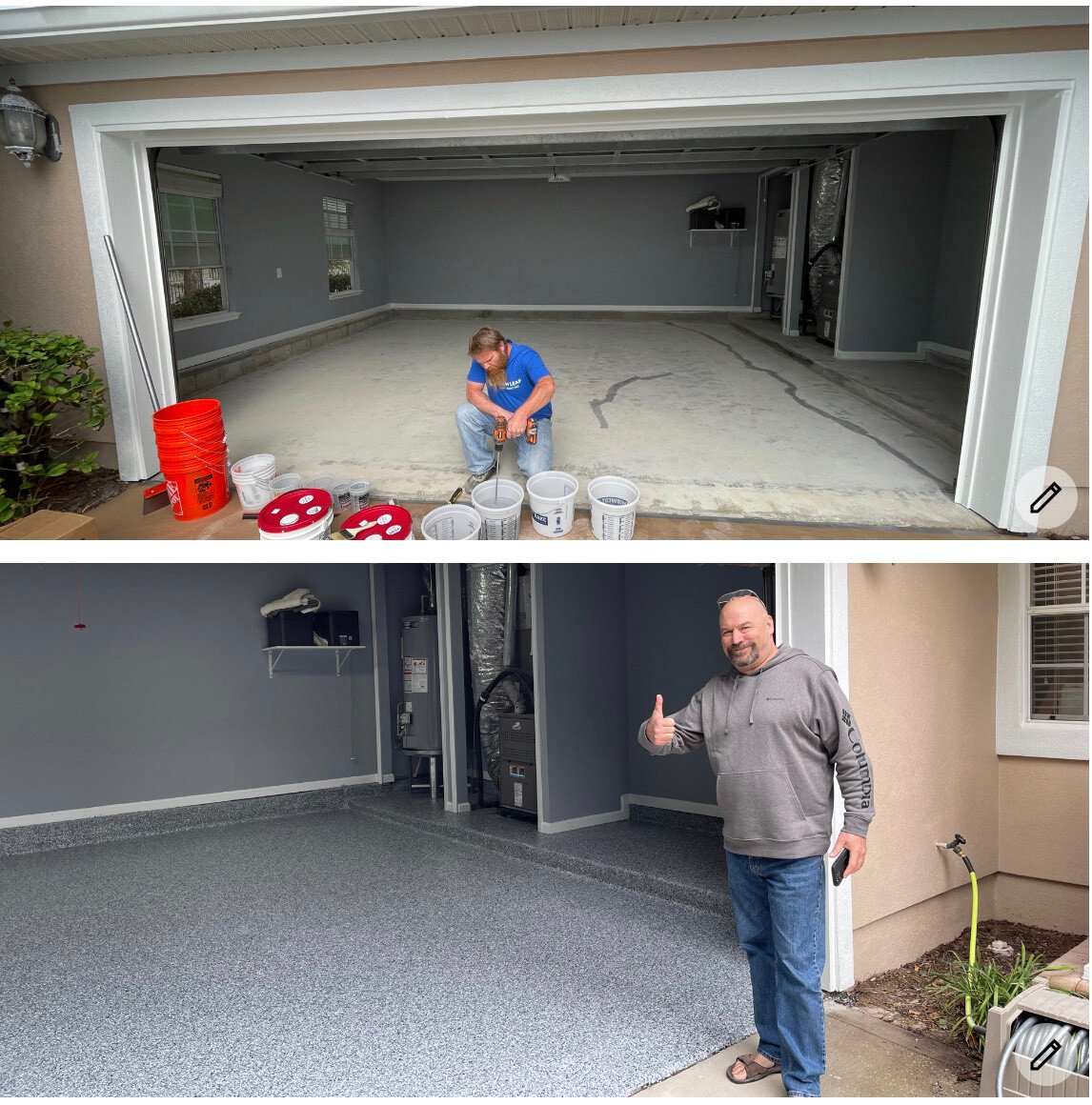
Every floor coating project begins with diamond grinding for proper surface preparation, moisture testing, crack repair, and a base coat application — because a coating is only as good as the surface underneath it. We use professional-grade polyurea and polyaspartic systems that cure in hours, resist hot-tire pickup, and hold up under Florida’s UV and humidity for 15 to 20+ years. Every project is backed by our Iron-Clad Guarantee: professional results or your coating is 100% free.
Wondering what it costs before you call? Our concrete coating cost guide breaks down real Jacksonville pricing so you know exactly what to expect before we ever set foot on your property. We also offer complete exterior painting, interior painting, stucco repair, carpentry repairs, and power washing — one company for everything your home needs. When you are ready, call or text 904-615-6599 for a free, no-surprise estimate.